
NetSpeek 1.5 May 2026 Release Notes
NetSpeek Platform 1.5 Update – May 8, 2026
The release of NetSpeek’s platform version 1.5 focuses primarily on easier deployment, improved scalability, and security hardening. This includes:
Instead of receiving NetSpeek Edge VM packages for hypervisor deployment through offline channels, customers can now download OVA files directly from the platform and onboard each Edge VM instance securely with a unique tenant-specific password. Extending on the capabilities of the 1.1 release, NetSpeek can remotely manage, monitor, and update Edge instances, so customers get the latest local integrations faster, with less manual effort and lower operational risk.
Alongside this, Lena’s stronger real-time streaming and structured-response architecture makes troubleshooting more reliable and moves the platform closer to 2.0.
Release highlights
- End-user Edge VM experience – Self-service OVA creation and download, simpler onboarding, and remote Edge updates
- Groups and sub-tenant workflows – New management interfaces and hierarchy-aware authorization
- Lena intelligence foundation upgrades – Native token streaming and structured response architecture improvements
- Troubleshooting hardening – Safer, more reliable room-check and action orchestration
- Next-generation settings experience – A reimagined settings UI with unified profile, scope, role, and sub-tenant workflows
- Portal quality improvements – Better account, password, location, image, and form flows
- Integration platform and device coverage – Faster delivery of new device integrations and more stable device communication under load
- Security baseline uplift – Tenant-specific Edge VM onboarding credentials plus CodeQL, CVE, CORS, CSP, and dependency hardening
1. End-user Edge VM Experience
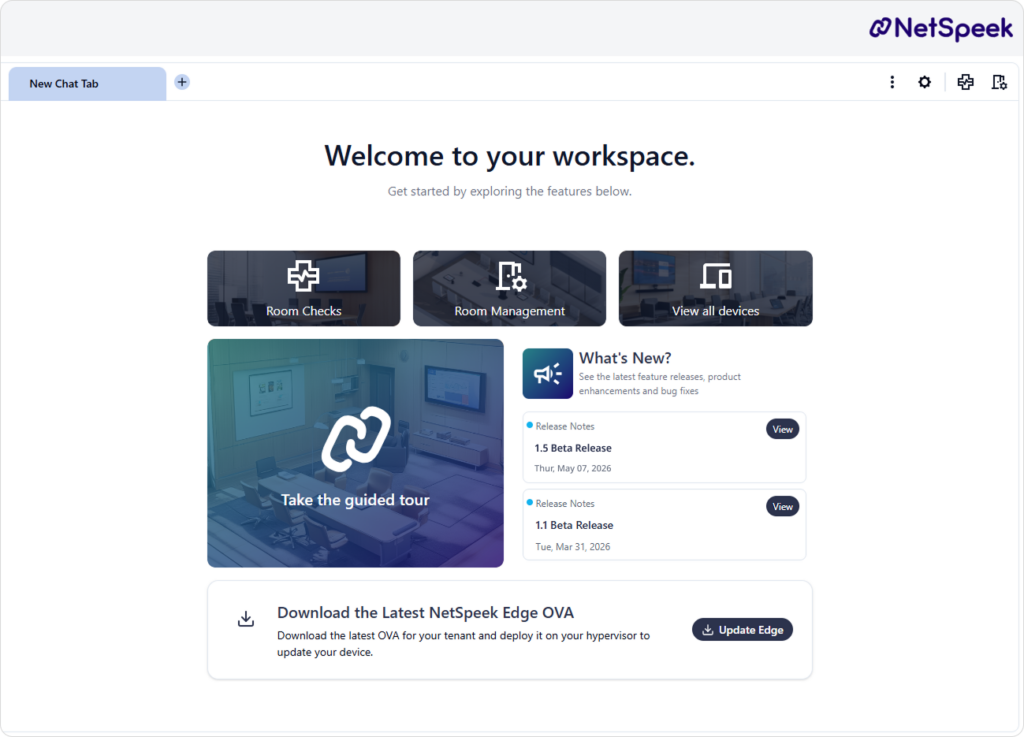
This release makes Edge deployments faster to start, easier to operate, and safer to maintain for customer teams.
What’s new:
- Platform OVA delivery – Teams can download the latest NetSpeek Edge VM OVA directly from the portal instead of relying on offline distribution channels
- Tenant-specific onboarding credentials – Each tenant receives a unique password during onboarding to strengthen Edge VM security from day one
- Remote lifecycle operations – NetSpeek can remotely manage, monitor, and update Edge VM instances to deliver local integration updates faster and with less manual effort
- Virtual appliance build orchestration – Added orchestration services for proactive OVA build and release handling
- Release catalog and deployment plumbing – Expanded release pipeline support for customer Edge VM update scenarios
2. Groups and sub-tenant management
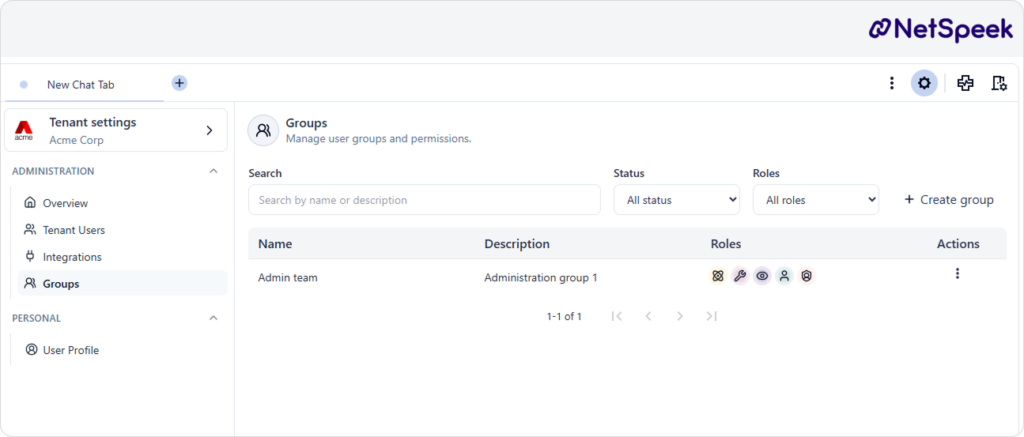
This release expands multi-tenant operational control with new groups UX, better hierarchy handling, and cleaner sub-tenant entry points.
What you can do:
- Manage groups in the portal – Use a new groups management UI with updated navigation and support utilities
- Apply hierarchy-aware access patterns – Use updated groups and customer API behavior aligned to stronger authorization checks
- Hierarchy-aware operational controls – Improved tenant-aware behavior across customer and group surfaces
3. Lena: streaming architecture and troubleshooting reliability

Lena now includes a new streaming and response architecture that improves response consistency, supports richer structured output handling, and strengthens troubleshooting execution safety.
Streaming and structured response pipeline
- Native token streaming – Improved response streaming behavior for text outputs
- Structured-first response flow – Structured response parts are prepared and streamed earlier in the pipeline
- State architecture cleanup – Legacy response flow components were retired in favor of a cleaner and faster model
- Handled-by tracking improvements – Better attribution and continuity across multi-step / multi-agent flows
Troubleshooting reliability upgrades
- Room-check guard hardening – Added stronger endpoint validation and guardrails around actionable operations
- Safer action orchestration – Added control protections, better fallback handling, and tighter status-action boundaries
- Improved aggregation correctness – Better date/version ordering and improved handling for compact variants
- Async context improvements – Reduced event-loop contention and improved reliability under load
4. A next-generation settings experience
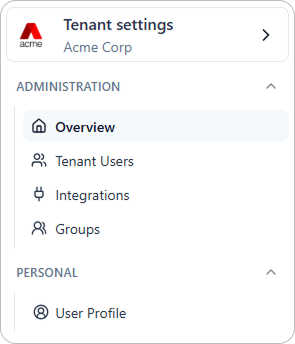
Settings has been rebuilt with a cleaner visual language and a more intuitive workflow. Account, profile, scope, role, and sub-tenant controls now live in one consistent surface, so customer teams find what they need with fewer clicks and less context switching.
What’s new:
- Redesigned settings UI – A modernized layout that brings clarity, consistency, and a more refined visual style across all settings surfaces
- Unified workflows – Profile, scope, role, and sub-tenant controls now live in one cohesive experience instead of separate entry points
- Built-in sub-tenant creation – Start sub-tenant workflows directly from settings with a clear, in-context action
- Cleaner navigation – Removed duplicated entry points so customers and partners can move through settings with less friction
- Foundation for upcoming governance – The new settings architecture is designed to host upcoming governance and identity controls (custom roles, group-level assignment, audit log UI)
5. Portal quality and UX improvements
This release delivers broad polish across login, password reset, profile and image handling, location forms, and in-product guidance copy.
What’s new:
- Forgot-password experience refresh – Clearer copy, better success feedback, and improved accessibility behavior
- Password form improvements – Better requirements guidance, validation timing, and input handling
- Location form guardrails – Stronger character-limit feedback and disabled-state clarity
- Image handling updates – Improved uploader requirements and visibility-driven loading behavior
- Support content refresh – Updated labels, help links, and in-product copy for clearer operator workflows
- Form/dropdown polish – Improved layout behavior for profile/settings and searchable dropdown interactions
6. Device coverage and integration platform
NetSpeek now delivers new device integrations faster and runs them more reliably under load – so teams get more value from their existing hardware investment with less waiting and less day-two friction.
What’s new:
- Faster delivery of new device integrations – We redesigned how device integrations are packaged and rolled out, so new vendor and model support reaches your Edge VM instances sooner and with less manual effort from your team
- More stable device communication under load – NetSpeek now handles concurrent device checks more efficiently, reducing timeouts and dropped connections in busy environments where many rooms are checked in parallel
7. Security and compliance baseline
This release contains a broad hardening pass across Lena, API, and web surfaces focused on known findings, safer defaults, and dependency risk reduction.
Security improvements:
Secrets and integrity improvements – Strengthened secret management posture and integration integrity controls
- CodeQL finding remediation – Addressed security and reliability findings across backend and AI services
- CVE patching across core dependencies – Upgraded vulnerable packages in Python and .NET paths
- CORS hardening – Replaced permissive defaults with explicit allowlist-driven origin handling
- Portal browser security headers – Added Content-Security-Policy, HSTS, clickjacking, MIME-sniffing, and referrer-policy protections at the portal hosting layer to defend against script injection and downgrade attacks
- Edge VM onboarding security improvements – Added tenant-specific onboarding credentials and tightened integration bundle safeguards
- Secrets and integrity improvements – Strengthened secret management posture and integration integrity controls